Sleep setup · Mattress compatibility
Can an Organic Mattress Work on an Adjustable Bed?
The appeal is easy to understand: a mattress made with natural materials, paired with a bed that can lift and lower at the touch of a button. But an organic label does not tell you whether a mattress can bend safely. Compatibility depends on the mattress’s construction, the adjustable base’s movement and support requirements, and—most importantly—what each manufacturer permits.
An adjustable bed changes the shape of the surface beneath you. Raise the head, lift the legs, or settle into a gentle incline, and the mattress must move with the base rather than resist it. That movement puts the sleep system to a practical test: the mattress needs enough flexibility to follow the platform while continuing to support the body evenly.
Organic materials can be part of a compatible mattress, but they are not a compatibility guarantee. Cotton, wool, latex, and other natural materials each behave differently, and the way they are assembled matters as much as the fibers themselves. A mattress may be marketed as organic and still be unsuitable for an adjustable base; another may use natural materials and work well if its design and warranty allow for repeated articulation.
The most reliable approach is deliberate rather than aesthetic. Before pairing an organic mattress with an adjustable bed, check the mattress warranty, the base manufacturer’s requirements, the mattress’s internal structure, and the dimensions of the two pieces of equipment. A considered match can preserve comfort and support. A guess can leave you with shifting layers, a strained mattress, or a warranty dispute.
First, separate the organic question from the flexibility question
“Organic” generally describes how specified materials are sourced, processed, or certified. It does not describe how a mattress will perform when the bed bends. Certification and composition can help you understand what is inside a mattress, but they do not replace construction details or instructions for use.
Flexibility comes from the whole design: the type and thickness of each layer, the way those layers are joined, the arrangement of any support elements, the cover, and the mattress’s overall profile. A thin, flexible mattress may respond differently from a thick model with a dense, rigid core. Two mattresses with similar natural-material claims can therefore behave very differently on the same base.
That distinction is particularly useful when researching organic mattresses online. Product descriptions often emphasize fiber origins, certifications, breathability, or handcraft. Those are meaningful details for some shoppers, but they do not answer the central adjustable-bed question. Look for explicit statements about adjustable-base use, permitted positions, and any restrictions. If the information is absent, ask the manufacturer before you buy.
Construction is the deciding factor
Adjustable beds typically use a segmented platform that raises and lowers sections of the sleep surface. The mattress has to bend across those transition points without buckling, separating, or losing its shape. Whether it can do so depends on its architecture, not simply on whether it feels soft in a showroom.
Layered foam and latex designs
Some foam and latex constructions are designed to flex, but materials vary in density, thickness, and resilience. A mattress built from multiple layers may be flexible as a complete unit—or its layers may shift or respond poorly when bent. Latex is available in different constructions and firmnesses, so the word “latex” alone cannot establish whether a model is suitable. Check the exact mattress specifications and manufacturer guidance.
Innerspring and hybrid designs
Coil systems range widely, and some are engineered for articulation while others may be intended for a flat, stable foundation. The number and arrangement of coils, the perimeter construction, and the layers above them all affect how a mattress responds to movement. A hybrid mattress, which combines coils with foam or other comfort layers, also needs to be evaluated as a complete system. Do not assume that a flexible comfort layer makes the entire mattress adjustable-base compatible.
Wool-filled and other natural-fiber designs
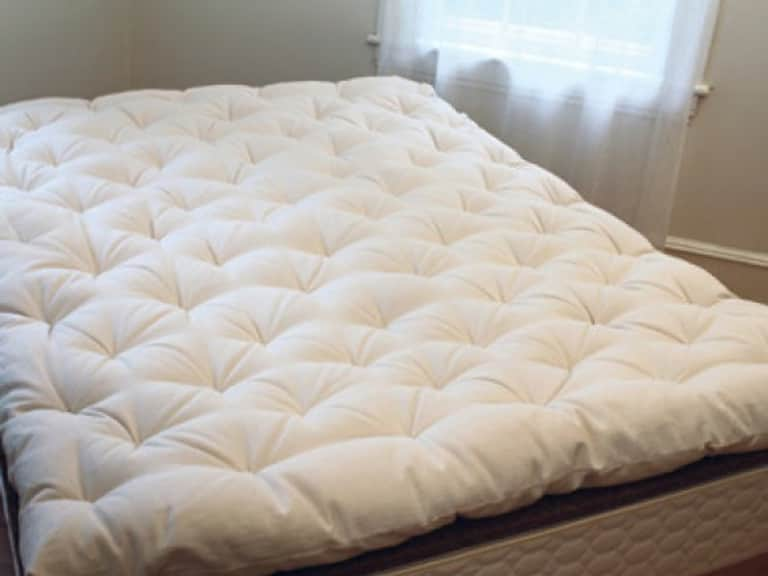
Natural fibers can make for a distinctive sleep surface, but a fiber’s breathability or temperature-regulating qualities do not tell you how well the finished mattress will bend. Wool batting, tufting, quilting, and the surrounding cover all contribute to the finished structure. Ask whether the particular mattress has been approved for the intended base and whether there are limits on how far or how often it may be raised.
For example, the Savvy Rest Pastoral Wool Mattress is described as a 4.5-inch mattress with GOTS-certified organic wool batting and a tufted organic cotton cover. Its description highlights breathability and its latex-free construction, but does not establish compatibility with adjustable bases. Anyone considering this mattress for an adjustable setup should confirm permitted use directly with the manufacturer and the base maker before proceeding. The material description is a starting point, not a verdict.
Read both warranties before choosing a setup
Mattress compatibility is a two-sided question. The mattress maker may specify which bases are acceptable; the adjustable-base maker may set rules for mattress type, thickness, weight, dimensions, or use. The combination needs to satisfy both sets of instructions.
Read the warranty and care documentation for the exact mattress model, rather than relying on general advice about a brand or material. Look for language that addresses adjustable foundations, articulated bases, power bases, platform frames, or bending. Check whether the warranty requires a particular type of support and whether improper use could affect coverage. If the wording is unclear, seek written confirmation and keep it with your purchase records.
Then review the adjustable base’s manual. It may specify a maximum mattress weight, recommended mattress dimensions, clearance requirements, or restrictions on using a mattress that is too thick or too rigid. Certain bases have moving parts that require unobstructed space. A mattress that is technically flexible may still be a poor match if its size or weight falls outside the base’s stated limits.
Warranty terms can change, and product specifications can vary by model or production period. Treat the current documentation for the specific items you are buying as authoritative. A salesperson’s verbal assurance may be useful, but written manufacturer guidance is more dependable when the question concerns coverage or safe use.
A practical compatibility checklist
Before placing an order, work through these questions. If any answer is uncertain, pause and verify it rather than assuming that a familiar material or brand name settles the matter.
- Does the mattress manufacturer approve adjustable-base use? Confirm the exact model, not just the general product category.
- Does the base maker permit this type of mattress? Check weight, dimensions, thickness, and any construction restrictions.
- Are there limits on movement? Ask whether certain positions, angles, or extended periods in an elevated position are discouraged.
- Will the mattress remain secure? Confirm that the base’s mattress-retention system is appropriate and that the mattress will not slide during adjustment.
- Are the two products the same size? A mismatch can create overhang, gaps, or uneven support and may interfere with movement.
- What does the warranty say? Verify that the intended base does not conflict with the mattress warranty or the adjustable base’s terms.
- Are accessories compatible too? Protectors, toppers, and fitted sheets should fit securely without restricting movement or pulling at the mattress.
This is not a test of whether a mattress feels pliable when pressed by hand. It is a check that the full sleep setup is approved for the movement you plan to use.
What to consider when choosing an adjustable base
Adjustable bases differ in features and specifications. Some offer independent head and foot movement; others add lumbar adjustment, head tilt, preset positions, or additional convenience features. Those options may shape your experience, but they do not change the need to check mattress compatibility first.
The The Clean Bedroom (Level 4) Adjustable Bed Base, for instance, is described with independent head and foot lift, head tilt, lumbar adjustment, adjustable leg heights, and platform- and pedestal-friendly placement. Its product details list different dimensions by size and a 750-pound lift capacity. Those base specifications are useful information when planning a sleep system, but they do not confirm that any particular organic mattress is suitable. Check the base instructions and the mattress manufacturer’s approval for the exact pairing.
Think through how you intend to use the base. If you expect to adjust the head or feet frequently, the mattress will experience repeated movement. If you prefer a particular elevated posture for reading or rest, ask whether the mattress maker permits that position. The base’s features should be matched to a mattress designed and approved to move with it—not used as a reason to stretch a mattress beyond its stated limits.
Protect comfort and support after installation
Once both manufacturers confirm compatibility, set up the bed carefully. Follow the base manual for assembly, placement, and operation. Make sure the frame is stable, the mattress sits squarely on the platform, and any retaining bar or strap is fitted as directed. If the base requires clearance from a wall or furniture, preserve it so the frame can move without obstruction.
Test adjustments gradually. Start with modest head or foot elevation and watch how the mattress behaves. The surface should follow the base without obvious buckling, sliding, or pulling at the edges. If you notice a new ridge, a pronounced fold, separation between layers, or movement that seems abnormal, return the bed to its flat position and consult the manufacturers. Do not force the base through resistance.
Use fitted sheets and protectors that suit the mattress dimensions and the base’s movement. Fabric that is too tight can pull at the corners as the bed rises, while a loose cover may shift. A topper can also affect how the bed articulates; check its fit and any relevant guidance rather than assuming that an accessory approved for a flat bed will behave identically on an adjustable one.
Routine care still matters. Follow the mattress’s instructions for rotation, cleaning, and ventilation, and follow the base’s manual for care and inspection. Do not lift or reposition a heavy mattress by pulling on its cover or seams. When moving the setup, use the handling instructions supplied by the manufacturers.
Common assumptions worth leaving behind
“Natural materials are automatically more flexible.”
Material origin does not determine the finished mattress’s ability to bend. The construction and manufacturer’s approved use are what matter.
“If it bends once, it will be fine long-term.”
A mattress might flex during a quick test without being designed for repeated articulation. A brief demonstration cannot replace documented compatibility or warranty guidance.
“Any adjustable base works with any adjustable-friendly mattress.”
Compatibility is specific to the two products. A mattress that can work on one base may fall outside another base’s size, weight, or construction requirements.
“An organic certification confirms performance.”
Certifications can speak to defined material or production standards. They do not, by themselves, certify flexibility, ergonomic performance, or suitability for an adjustable bed.
Questions to ask before you buy
A concise conversation with the manufacturer can prevent an expensive mismatch. Ask direct questions and request answers that identify the exact model and intended setup:
- Is this specific mattress approved for use on an adjustable base?
- Are there base types, positions, or angles that should be avoided?
- Does using an adjustable base affect the mattress warranty?
- Are there minimum or maximum mattress thickness and weight requirements?
- Does the base have limits on mattress construction or accessories?
- What signs of strain or incompatibility should prompt us to stop using the setup?
Keep the responses, manuals, and receipts together. This is especially useful if the mattress and base are purchased from different makers, since each company may describe compatibility from the perspective of its own product.
The bottom line
An organic mattress can work on an adjustable bed, but the word “organic” does not answer the question. The mattress must be flexible enough for the base’s movement, constructed to maintain even support as it bends, and approved for that use by its manufacturer. The base must also accommodate the mattress’s size, weight, and design.
Start with the exact product documentation, confirm compatibility with both manufacturers, and treat warranty conditions as part of the decision—not fine print to revisit later. If the guidance is unclear, wait for clarification before buying or operating the combination. The most elegant sleep setup is not simply a collection of appealing materials and features; it is a system whose components are designed to work together.
With that groundwork in place, natural materials and adjustable positioning need not be competing priorities. The right pairing is the one that respects the mattress’s construction, the base’s requirements, and the support your sleep environment is meant to provide.